Strategies for manging work/life after having kids
It was interesting to note the contradictions in perspectives on the
work/family balance among the different speakers.
There is not one single equation for success in these sorts of
situations. What works best for one professor/mother
depends on individual factors of personality, family constraints,
work contraints and so forth.
Here we present an amalgamation of the different points of view and
pieces of advice.
Some of the speakers have nannies who come in to the house to take
care of the children. Others have relied instead on a day care
or pre-school situation during the pre-school years.
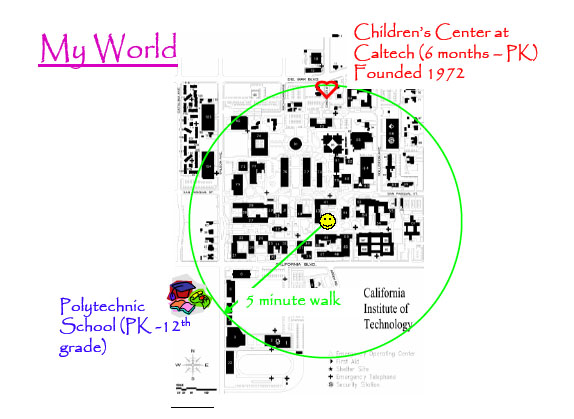
Prof. Hunt feels fortunate that her children
have been cared for and educated within a five minute walk of her
office. Caltech has an on-site day care center (started in 1972 and
founded by a group of faculty wives and Caltech staff members), which
enrolls children from 6 months to 5 years of age. While her girls were
young, she was very active in the Children's Center at Caltech serving
on the board for a total 4 years with 3 years as the president. It is
a high-quality program; it was a terrific resource during the early
years.
Her children now attend Polytechnic School, which is near the
southwestern corner of campus. This school was started as the
spin-off from the Throop Polytechnic years. It is a private
independent school with children from pre-kindergarten through 12th
grade. Her children have enjoyed their years at Poly, and she is able to
easily run over for the occasional class play, skinned knee, choir
performance, student-teacher conference, etc.
Most of the speakers made similar comments about the flexibility of
academic life.
Academic jobs offer flexibility that you can't find in many other
professions. This flexibility is a great asset in child rearing.
Certain commitments such as lectures and office
hours cannot be switched around freely, but other time during the day
is spent doing research, or meeting with individual graduate students,
where there is tremendous flexibility in the scheduling. This
has the advantage of allowing faculty parents to attend events at
their children's school or pre-school relatively easily, more easily
than most women in industry would find it.
Prof. Cosman has a nanny/housekeeper who comes in to her home each
work day. This has the advantage that the nanny can wash the dishes
and do the laundry while the 1-year-old is sleeping. Prof. Cosman
feels it is an enormous benefit to have the housework done, so she
can devote her home time to being with the children.
Prof. Wadia-Fascetti commented on the importance of reliability
in child care, and of always having a back-up plan in case the main
plan falls through. Part of Prof. Cosman's back-up plan is to never
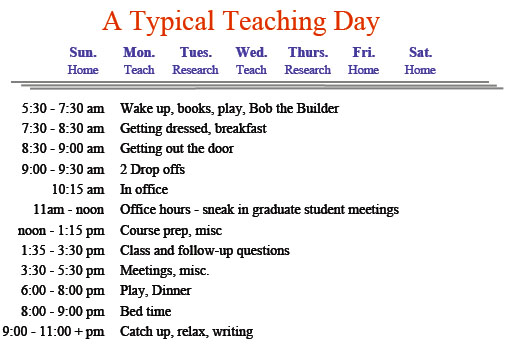
teach a class earlier than 10:00 in the morning. In case one wakes up
in the morning to find that the nanny is sick, and can't come to work
(happens less than once per year), one needs a bit of time to react, and
to activate plan B, and with teaching an 8am class there would be no
time to react.
When people talk about whether it is
possible to "do it all" the answer depends on what you mean by "all".
If what you mean by "all" is having an exciting, intellectually
stimulating career, and also having a loving family with which
one can enjoy plenty of time, then the answer is yes, it is possible to
have it all. But the answer is NO if the "all" means the above two
items, plus also the following: (a) having a house which is at all times
ready to be photographed inside and out for Architectural Digest,
(b) keeping up with all your pre-children hobbies of bonsai-cultivation,
ballroom dancing, rock climbing, and tae kwon do, (c) spending lots
of quality time alone with your spouse, and (d) throwing dinner parties
and entertaining your friends regularly with haute cuisine and decorations
that would teach Martha a thing or two. In short, having kids and a
career will be about all that can be done, and (a),(b),(c), and (d) will
largely have to go by the wayside.
In essence, this is a matter of redefining one's priorities at home,
after the arrival of a child. As discussed below, the same kind of
redefining priorities takes place at work as well, after a child is born.
Prof. Bhatia commented that before having a baby, her priorities at home
(that is, everything not pertaining to work) were her marriage,
taking care of herself, her house, extended family, and friends. After
having a baby, the baby became the number one priority, while the house
and the friends became tremendously reduced in importance.
Prof. Cosman concurred with this sentiment, giving examples such as
postponing a car wash (car washes are never needed, because it rains
in December) and ignoring the spots in the carpet (carpet spots should
be literally beneath one's notice).
Whenever possible, find ways of
sharing the jobs that need to be done. Prof. Hunt commented that she
drives a big mini-van and carries a big purse, neither of which she
would do if she didn't have children. They are symbolic of the types of
choices that we make. Although she doesn't need the minivan just for her
own two kids, she believes in carpooling and is happy to drive other
children because she knows that her children may be in need of a ride in the
near future. The big purse is the family carry-all.
In a similar vein, Prof. Cosman commented that she issues almost
all of her dinner invitations
as potluck dinners. While this may not be considered the height of
elegance by some, it allows her to enjoy lots of social time with friends
and family, without having to leave work early to get the cooking done,
or having to stay up to midnight the night before. In any case, guests
are going to feel bound to bring something, and better that they should
bring something useful instead of a box of chocolates or a bottle of wine.
Everyone agreed that it was
important to maintain some time for yourself (for example, having
time for exercise) and for your spouse (occasionally going out on dates).
As Dr. Goulden's data on faculty divorce rates showed, academic
life can put a lot of stress on a marriage, and it is important to
go out with one's spouse! Prof. Wadia-Fascetti said she tries to
have regular Friday nights out with her husband. Prof. Cosman wishes
she could have regular date nights! But even just putting the toddler in
the stroller and walking around the block with her husband can feel
like a nice micro-date.
A number of topics were discussed about work, including
re-ordering one's priorities
at work after the arrival of a baby, travel, off-loading
responsibilities, and planning.
After having a child, all the speakers agreed
that priorities at work got re-examined. For example,
Prof. Bhatia had a pre-baby list of
priorities that began with Research (funding, managing a lab, publishing),
next had Teaching (writing books, classroom teaching, and web-based
materials), and then Service (at the department, university, and
national levels). After having a baby, the tasks of managing a lab,
as well as all components of teaching and service were reduced in importance.
Only publishing and maintaining funding were still considered of
prime importance.
All the speakers addressed the difficulties of travel.
There was huge variation in opinion. Prof. Hunt said she travelled
extensively, and thought that it was important professionally to do so.
Frequently she would cut down on the number of days of travel, however,
going to just one or two days of a conference, rather than attending the
full conference. The opinion of several people
was that professional networking is
valuable, and presenting seminars at other universities is a very useful
way of building visibility and making connections with people who will
write tenure letters.
Prof. Bhatia said that she made typically one overnight trip per month,
usually 3 days with 2 nights. In addition she would make some trips
that did not include overnights.
At the opposite extreme, Prof. Cosman said she made only one professional
trip each year, and in fact had no travel at all in some years. She did not
think it was particularly important professionally to go to conferences
or to present seminars at other universities. Students can be sent
to conferences, and in that way the research will still gain visibility.
The students are always happy to go, since that way they can travel a bit,
as well as getting some visibility for themselves.
One thing most speakers agreed on was the need for planning trips in
advance, and the need for careful coordination with one's spouse.
Several speakers commented on the fact that an academic job allows
for plenty of family travel. Because the university schedule is well
lined up with children's school schedules, most faculty members can take
2-3 weeks of summer travel with the kids, as well as a week during winter
break, and various smaller trips at other times.
It's tremendously helpful if one can delegate some
jobs to a competent lab manager or
administrative assistant. Most faculty members have
assistants who do copying for classes, handle travel arrangements and
reimbursements, and purchase office supplies at the bookstore. But
sometimes assistants are under-used, and with a little thought,
one can often find various additional
ways in which they can help out: designing the faculty member's web site,
getting books from the library, downloading papers off the web,
making handsome electronic drawings of circuit diagrams for the exams,
etc. For those faculty members who maintain laboratories or computers,
investing money in competent help such as computer system
administrators or lab managers can be a very wise choice.
Some people commented on the need for
advance planning, and never leaving things for the last minute.
For example, some male faculty members might prepare their lectures
in the few hours before they actually give the lecture.
For a woman faculty member with children, that might be a risky thing
to do. Suppose the child wakes up sick, and has to be taken to the doctor?
Even if one has a nanny, the nanny cannot take the child to the doctor.
Or suppose the nanny is sick, and doesn't show up, and some back-up
child care plan needs to be activated involving a grandparent or friend.
The lecture preparation time vanishes. So, things always need to be done
in advance, because the faculty Mom knows she can't count on the hours to
be there necessarily on any particular morning, unless of course the father
is the first line of defense against unexpected events of this type.
Robert M. Gray, September 12, 2004